The Naturalization Civics Test: How to Prepare
The naturalization civics test is a spoken exam covering U.S. history and government. An officer asks up to 10 questions drawn from an official 100-question list, and you need to answer at least 6 correctly. Free USCIS study materials make preparation straightforward. If you miss the mark, you get one retake. Understanding the format ahead of time takes most of the surprise out of interview day.

What the Naturalization Interview Actually Looks Like
Many applicants picture the naturalization interview as a formal courtroom scene. In reality, it takes place in a quiet office at a USCIS field office — in the Chicago area, that is typically the USCIS Chicago Field Office located in the city. You sit across from a USCIS officer who reviews your Form N-400 (Application for Naturalization) with you and then administers two short tests: an English test and a civics test.
The whole appointment usually lasts less than an hour, and officers are trained to put applicants at ease. The tone is conversational, not adversarial. That said, knowing exactly what to expect makes a real difference in how confident you feel when you sit down.
The English test actually begins the moment you walk in. The officer is evaluating three things throughout the interview:
- Reading — you will be asked to read one sentence aloud from a set of sentences printed on a card or displayed by the officer.
- Writing — the officer will dictate one sentence for you to write down.
- Speaking — your answers to questions about your N-400 application serve as the speaking component. There is no separate 'speaking section.'
Most applicants who have been living and working in the United States in English find the English portion manageable. If you are 50 years old or older and have been a lawful permanent resident for at least 20 years — or 55 years old or older and a resident for at least 15 years — you qualify for an exemption from the English test. You will still need to take the civics test, but you may do so through an interpreter. Check the USCIS website for full details on age and residency exemptions.
After the English test, the officer moves to the civics portion. This is the part most people spend the most time preparing for, and for good reason — it covers a broad range of American history and government topics.
Inside the Civics Test: The 100 Questions
USCIS publishes an official list of 100 civics questions and answers, and every question the officer can ask comes directly from that list. There are no surprise questions, no trick questions, and no obscure trivia from outside the official pool. This is genuinely good news for applicants: the test is entirely open-book during your study period.
The 100 questions are grouped into two broad categories:
American Government
- Principles of American democracy (what the Constitution does, the rule of law, the Bill of Rights)
- System of government (the three branches, Congress, the President's role, the Supreme Court)
- Rights and responsibilities of citizens
American History
- Colonial period and independence
- The 1800s (the Civil War, Reconstruction, westward expansion)
- Recent American history and other important historical developments
During your interview, the officer will ask you up to 10 questions chosen from the 100. You need to answer at least 6 correctly to pass. The officer stops asking as soon as you have 6 correct answers, so you may not be asked all 10.
A few questions on the list have answers that change based on current officeholders — for example, who is the current President, Vice President, your state's governor, or your U.S. senators. For those questions, USCIS expects the answer that is correct at the time of your interview, not when you began studying. Illinois residents should note that the answers for Illinois governor and Illinois U.S. senators will differ from those given by residents of other states. Make sure you look up the current officeholders for Illinois before your interview date.
One additional note: USCIS has periodically updated its civics test. There is currently an established version of the test. Always confirm on uscis.gov which version applies to your application, because the version you are tested on can depend on when you filed your N-400.

Official Study Materials — All Free
You do not need to buy a prep course, a flashcard app, or a study book. USCIS provides a full suite of free, official study resources, and these are the most reliable materials you can use.
What USCIS offers:
- The official 100 questions and answers — downloadable as a PDF in both the standard version and a large-print version. The list includes notes on which answers may vary.
- Flashcards — USCIS offers printable flashcard pages so you can quiz yourself or study with a family member.
- Civics practice test — an interactive online quiz on the USCIS website that lets you simulate the 10-question format.
- Audio and video resources — short videos explain each section of the civics content and walk through the history and government concepts behind the questions. These are particularly helpful if you are a stronger auditory learner.
- Study booklet — a readable guide that gives context for the questions, not just the bare answers.
Practical study tips:
- Start with the full list and identify which questions you already know. Concentrate your energy on the ones you do not.
- Study in short, regular sessions — 15 to 20 minutes a day is more effective than one long cram session.
- Use the flashcards in both directions: see the question and recall the answer, then see the answer and recall the question.
- Practice saying your answers out loud. The test is spoken, and the words need to come naturally under mild pressure.
- Ask a family member, friend, or neighbor to quiz you randomly from the 100-question list during the weeks before your appointment.
- Pay special attention to the questions with variable answers — update your answers for current Illinois officeholders close to your interview date.
All of these materials are available at no cost at uscis.gov/citizenship/find-study-materials-and-resources. There is no registration required and nothing to purchase.
Accommodations, Exemptions, and the 65/20 Exception
The standard civics test is designed for the general applicant population, but USCIS has built in meaningful accommodations for older applicants and those with disabilities.
The 65/20 exception (sometimes called the 'senior exception'): If you are 65 years old or older and have been a lawful permanent resident for at least 20 years, you qualify to be tested on a shorter list of just 20 civics questions rather than the full 100. You still need to answer 6 out of up to 10 questions correctly, but your study pool is significantly smaller. The 20-question list is also published on the USCIS website and is clearly marked.
Disability accommodations (Form N-648): If you have a physical or developmental disability or a mental impairment that prevents you from meeting the English or civics requirements, a licensed medical professional can complete Form N-648, Medical Certification for Disability Exceptions, on your behalf. USCIS reviews these on a case-by-case basis. This is a formal process, and the form must be filled out carefully and completely by the medical provider — not by the applicant.
Interpreter use: Applicants who are exempt from the English requirement (based on age and residency, as described earlier) may bring a qualified interpreter to their civics interview. The interpreter must not be the applicant's attorney or accredited representative. USCIS has specific rules about who may serve as an interpreter, so review those guidelines on uscis.gov before your interview date.
Medical or other emergency accommodations: If you have a temporary condition on the day of your interview — for example, a serious illness — contact USCIS promptly. Rescheduling is possible, though it will add time to your overall process. Do not simply skip the appointment without notifying USCIS, as that can cause your application to be administratively closed.
What Happens If You Don't Pass: The Retake Rule
Not everyone passes on the first attempt, and that is nothing to be ashamed of. USCIS builds a safety net into the process.
If you do not pass the English test, the civics test, or both during your initial interview, USCIS will schedule you for one retake interview, which typically occurs within 60 to 90 days of your first interview. At the retake, you are only re-tested on the portion or portions you did not pass. If you passed the English test but not the civics test, you only need to retake the civics test.
If you do not pass on the retake, USCIS will deny your N-400 application. At that point, you would need to file a new application and begin the process again, including paying the filing fee. This is why thorough preparation before your first interview is the best strategy — not because one failure is catastrophic, but because it delays your path to citizenship by months.
Between your first interview and your retake:
- Continue using the official USCIS study materials.
- Focus specifically on the question types or content areas where you struggled.
- Practice under timed conditions — give yourself about 10 seconds to answer each question, which mirrors the pace of the actual interview.
- If you passed some civics questions but not enough to reach 6 correct, study the entire 100-question list rather than guessing which questions will be chosen next time.
There is no penalty for using your retake opportunity. It exists precisely because USCIS recognizes that nerves, language challenges, or simply an unlucky draw of questions can affect performance on a given day.
The Oath Ceremony: Your Final Step — and a Chicago Tradition
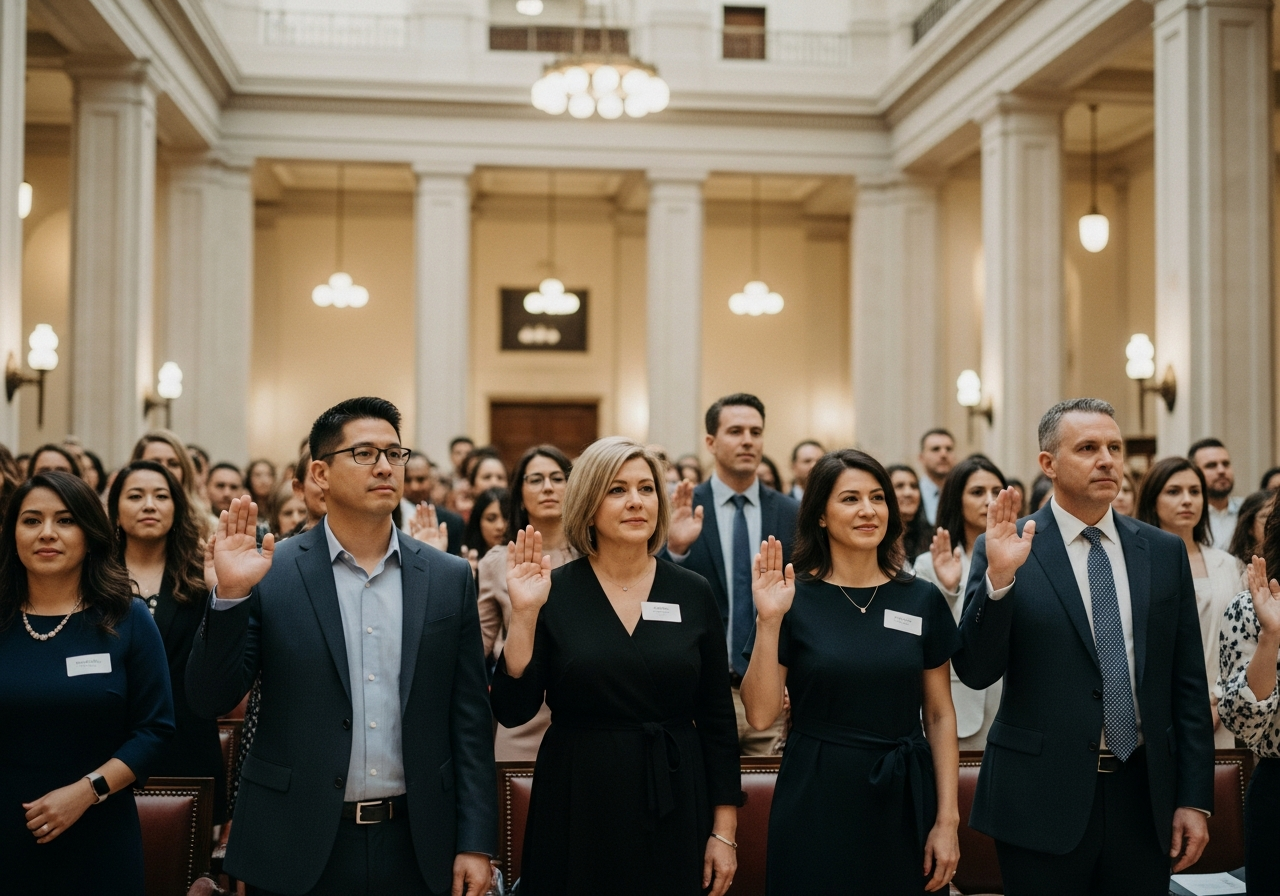
Passing the civics and English tests does not make you a citizen on the spot. After USCIS approves your application, you must attend an Oath of Allegiance ceremony before your naturalization is complete. It is at this ceremony — when you recite the Oath and receive your Certificate of Naturalization — that you officially become a U.S. citizen.
USCIS conducts oath ceremonies in two ways:
- Administrative ceremonies — held at the USCIS field office, often on the same day as or shortly after a successful interview. These are smaller and more routine.
- Judicial ceremonies — held in a federal or state courthouse, often with larger groups of new citizens. These tend to feel more formal and celebratory.
In the Chicago area, naturalization ceremonies are a meaningful civic event. The Dirksen Federal Building — which houses the U.S. District Court for the Northern District of Illinois — has hosted large, memorable oath ceremonies where hundreds of new citizens take the Oath together in a grand courtroom setting. Some Chicago-area ceremonies also take place at other locations including libraries, historic landmarks, and civic spaces, particularly around patriotic holidays like Independence Day and Constitution Day (September 17). These larger ceremonies often include community remarks, a welcome from local officials, and a moment that many new citizens describe as one of the most moving experiences of their lives.
After your ceremony, you will surrender your Permanent Resident Card (Green Card) and receive your Certificate of Naturalization. Guard this document carefully — it is your primary proof of citizenship. You can then apply for a U.S. passport, register to vote in Illinois, and access all the rights and responsibilities of U.S. citizenship.
A few practical notes for ceremony day:
- Bring your appointment notice and any documents USCIS requests.
- Arrive early — these events are organized gatherings with security screening.
- Bring family members if the ceremony format allows guests; many Chicago-area ceremonies do.
- If you need to reschedule a ceremony date, contact USCIS as soon as possible.
The road to citizenship takes time and effort, but the civics test is one part of the journey where preparation genuinely pays off — and where the finish line, an oath ceremony in a Chicago federal courthouse or community hall, makes the work feel entirely worth it.
Frequently Asked Questions
The editorial team researches and writes plain-language immigration information, drawing on official government sources and reviewing each page for clarity and accuracy.
Sources & Citations
- [1]Official Government Source: USCIS: Civics Test Study Materials and Resources
- [2]Official Government Source: USCIS: The Naturalization Interview and Test
- [3]Official Government Source: USCIS: Exceptions and Accommodations (Form N-648)
- [4]Official Government Source: USCIS: Oath of Allegiance
- [5]Official Government Source: USCIS: Form N-400, Application for Naturalization
More immigration insights
Insights


Need help with your immigration case?
Our experienced Chicago immigration attorneys offer flat-fee consultations to review your case and outline clear next steps.
Request a Consultation